

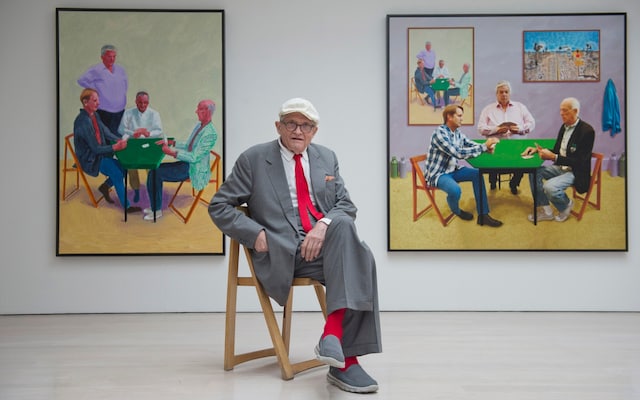
LONDON — David Hockney, the celebrated British artist whose vibrant paintings, fearless experimentation, and enduring curiosity helped reshape contemporary art for more than six decades, has died at the age of 88. His death marks the passing of one of the most recognizable and influential creative figures of the modern era, an artist whose work transcended galleries and museums to become part of global popular culture.
Few artists succeeded in balancing critical acclaim with widespread public affection as effectively as Hockney. Throughout a career spanning more than 60 years, he remained both a respected innovator among scholars and a beloved cultural figure whose works were instantly recognizable to audiences around the world.
Born in Bradford, England, in 1937, Hockney emerged from modest beginnings to become one of Britain’s most celebrated living artists. His rise coincided with a transformative period in postwar art, but unlike many of his contemporaries, he refused to be defined by a single style or movement. Instead, he built a reputation on constant reinvention.
His breakthrough came after his first visits to California in the 1960s. Captivated by the region’s bright sunlight, modern architecture, and swimming-pool culture, Hockney produced a series of works that would become landmarks of 20th-century art. Paintings such as A Bigger Splash, Peter Getting Out of Nick’s Pool, and Portrait of an Artist (Pool With Two Figures) combined technical sophistication with emotional depth, exploring themes of identity, desire, memory, and observation.
Art historians frequently described Hockney as a bridge between traditional painting and contemporary visual culture. While deeply influenced by masters such as Cézanne, Picasso, and Matisse, he continually pushed artistic boundaries through photography, printmaking, stage design, photocollage, and eventually digital media.
His willingness to embrace new technology distinguished him from many artists of his generation. Decades before digital art entered mainstream conversation, Hockney was experimenting with computer-generated images, fax-based artworks, and later iPhone and iPad drawings. These innovations reflected a lifelong belief that artistic tools may change, but the act of seeing remains central to creativity.
That philosophy helped sustain a remarkable level of relevance well into his later years. Major retrospectives at leading institutions in London, New York, Paris, and elsewhere drew record-breaking crowds, while his works continued to command extraordinary attention from collectors and critics alike. In 2018, Portrait of an Artist (Pool With Two Figures) sold for more than $90 million, briefly making it the most expensive artwork ever sold by a living artist.
Yet Hockney’s greatest achievement may have been his ability to make art feel accessible. Whether painting Yorkshire landscapes, California pools, intimate portraits, or digital springtime scenes from Normandy, he invited viewers to look more carefully at the world around them.
Tributes from artists, curators, collectors, and admirers have begun pouring in, reflecting the breadth of his influence across generations and continents. Many have remembered him not only as a master painter but also as a restless observer whose enthusiasm for life and creativity never diminished.
David Hockney leaves behind a body of work that fundamentally changed how people think about color, perspective, technology, and visual storytelling. His legacy endures in museums, galleries, classrooms, and countless artists’ studios around the world.
He is survived by his longtime partner, Jean-Pierre Gonçalves de Lima, and members of his family. While the art world mourns the loss of a giant, Hockney’s paintings remain a vivid reminder of his enduring message: that seeing the world with curiosity is itself an act of creation.